
Lancaster Kitchens & Baths | Serving Lancaster County and Surrounding Communities
A kitchen cabinet project gone wrong is not a minor inconvenience. It is a disruption that lives with you every morning when you open a door that is not level, every evening when a drawer sticks in the middle of cooking, and every time a visitor sees that the upper cabinet run does not sit flush with the tile backsplash or that the gap between two base cabinets is wider on one side than the other. Unlike a paint color you can repaint or a hardware choice you can swap in an afternoon, cabinet installation problems are structural. Correcting them means removing and reinstalling cabinets, reordering components that were cut wrong, repairing the walls or countertops that were affected, and absorbing the cost of the labor required to do all of it over again.
The national data on what goes wrong in kitchen cabinet installation is striking. Research across the industry finds that DIY cabinet installation produces significant errors requiring costly rework in approximately 20 percent of projects. Complete cabinet removal and reinstallation costs $3,000 to $8,000 beyond the original project cost. Reordering custom or semi-custom cabinets that were measured incorrectly adds six to twelve weeks to the project timeline on top of that cost. And those figures address only the direct financial consequences — they do not count the weeks or months of living with an unusable or incomplete kitchen while corrections are made, or the cumulative daily frustration of cabinets that function poorly because installation quality did not match the quality of the product selected.
For Lancaster County homeowners making a meaningful investment in their kitchen, the case for professional installation is not a matter of convenience. It is a matter of protecting the investment from the specific, well-documented failure modes that amateur installation produces.
The Most Expensive Mistake: Measurement Error
Every kitchen cabinet project begins and ends with measurement. The measurements taken before ordering determine what is purchased. The measurements taken during installation determine how precisely every cabinet is positioned, leveled, and coordinated with every adjacent component. A measurement error at either stage produces consequences that are difficult and expensive to undo.
Pre-installation measurement errors — ordering cabinets that are the wrong size for the specific kitchen conditions — result from failing to account for the full range of variables that affect fit. Standard wall cabinet width and height do not account for window trim that extends into the cabinet run’s clearance zone. Base cabinet depths do not automatically account for the specific dishwasher model being installed and whether its door handle conflicts with an adjacent base cabinet when fully open. Corner cabinet specifications require understanding of the diagonal dimension of the corner as-built, not the nominal dimension on the floor plan, which in older Lancaster County homes can differ significantly from what the original construction drawings showed.
Professional installers measure the kitchen in the field, not from plans, and they measure at multiple heights and across multiple points because walls in real homes — especially the historic homes that define Lancaster City, Lititz, and Ephrata — are rarely plumb or perfectly square. A wall that measures 108 inches across the floor may measure 107.5 inches at the level where upper cabinets mount, a discrepancy that is invisible until cabinets are being installed and the run does not close cleanly at the corner.
The installation measurement requirements add another layer. Cabinets must be installed level regardless of whether the floor, ceiling, or walls are level — and in most homes, none of those surfaces are perfectly level. Establishing the high point of the kitchen floor, setting the base cabinet height reference from that point, leveling every cabinet in the run relative to that reference, and using shims to compensate for floor and wall variation without creating visible inconsistency in the installed product requires both technical understanding and practiced skill. Rushing or skipping these steps produces the sloping cabinet runs and uneven base heights that make a kitchen look amateurish regardless of how expensive the cabinets themselves were.
Structural Anchoring and the Safety Consequence of Getting It Wrong
Wall cabinets are heavy. A fully loaded upper cabinet run containing dishes, glasses, canned goods, and small appliances can easily weigh several hundred pounds — weight that must be transferred through the cabinet mounting system into the wall structure behind the drywall. Mounting that system to drywall alone, without anchoring into the wall studs behind it, provides no meaningful structural support. The mechanical connection between the cabinet screw and the drywall paper and foam will eventually fail under sustained load, and when it does, cabinets and their contents come down together.
Finding and anchoring to wall studs sounds straightforward, but in practice it requires tools, technique, and knowledge of where to verify what a stud finder shows. Old plaster walls — common in Lancaster County’s historic homes — behave differently than modern drywall under a stud finder and can produce false positives that lead installers to mount into plaster keys rather than studs. Cabinets that are not anchored to studs represent not just an installation quality failure but a safety hazard that a homeowner may not discover until a cabinet comes loose years after installation.
Where stud locations do not align with cabinet mounting points — which happens regularly in older homes where stud spacing is not consistent with modern standards — professional installers add backing boards secured to the studs before cabinet installation, creating a continuous anchor surface that allows secure mounting regardless of where the cabinet fall line happens to land. This is not a technique that appears in DIY instruction guides, but it is standard practice for professional installation teams working in Lancaster County’s varied housing stock.
The Coordination Problems That Surface During Installation
The most difficult installation problems to anticipate are the ones that only appear when all of the project’s moving parts interact. The countertop fabricator measures the countertop after base cabinets are installed and level, but if base cabinet heights are inconsistent from one run to the next, the countertop template captures that inconsistency and the finished counter has height transitions at the seam between runs. The under-cabinet lighting electrician needs to know finished upper cabinet dimensions and positions before running rough wiring, but if the cabinet layout shifted during installation due to field conditions, the rough wiring positions do not match the cabinet positions and one or both must be modified.
These coordination failures are preventable when a single experienced team manages the project scope and its subcomponents communicate with each other in real time. They are essentially inevitable when a homeowner independently contracts each trade and relies on the trades to coordinate among themselves — a scenario that routinely produces the back-charges, schedule delays, and quality compromises that make “I should have used one company for all of it” the most common regret in Lancaster County kitchen remodels.
The NKBA’s research cited in both Kitchen Cabinet Installation in Lancaster County, PA: What Homeowners Need to Know in 2026 and Stock, Semi-Custom, or Custom: Which Kitchen Cabinet Grade Is Right for Your Lancaster County Home? documents that professional involvement in higher-investment kitchen projects is nearly universal among homeowners who achieve the outcomes they planned for — and that the projects where professional involvement is limited or piecemeal are disproportionately represented in the population of remodels that go significantly over budget or result in outcomes the homeowner was not satisfied with.
What Professional Installation Actually Looks Like
Professional kitchen cabinet installation from an experienced team is not simply a faster version of what a homeowner would attempt themselves. It is a different process executed with different tools, different knowledge, and different quality checkpoints built in at every stage.
The pre-installation site assessment identifies conditions that affect the installation before any cabinet is on the wall — floor level variations, wall plumb deviations, stud locations, utility positions, and any structural quirks the field conditions reveal that the design drawings did not show. That assessment allows adjustments to be made at the planning stage rather than the installation stage, which is always faster and less expensive.
The installation sequence matters as much as the execution. Upper cabinets are installed before base cabinets in most configurations, allowing free access to the wall without base cabinets in the way. Cabinets are leveled to a reference line established from the floor’s high point, established across the full kitchen run before individual cabinets are positioned. Cabinet runs are joined tightly with proper connectors before being anchored to the wall, preventing the gaps between adjacent cabinets that accumulate and widen over time when cabinets are mounted individually and then brought together. Door alignment and drawer adjustment are completed after all cabinets are in position, not during installation, because the final adjustment depends on the full assembled run being stable and complete.
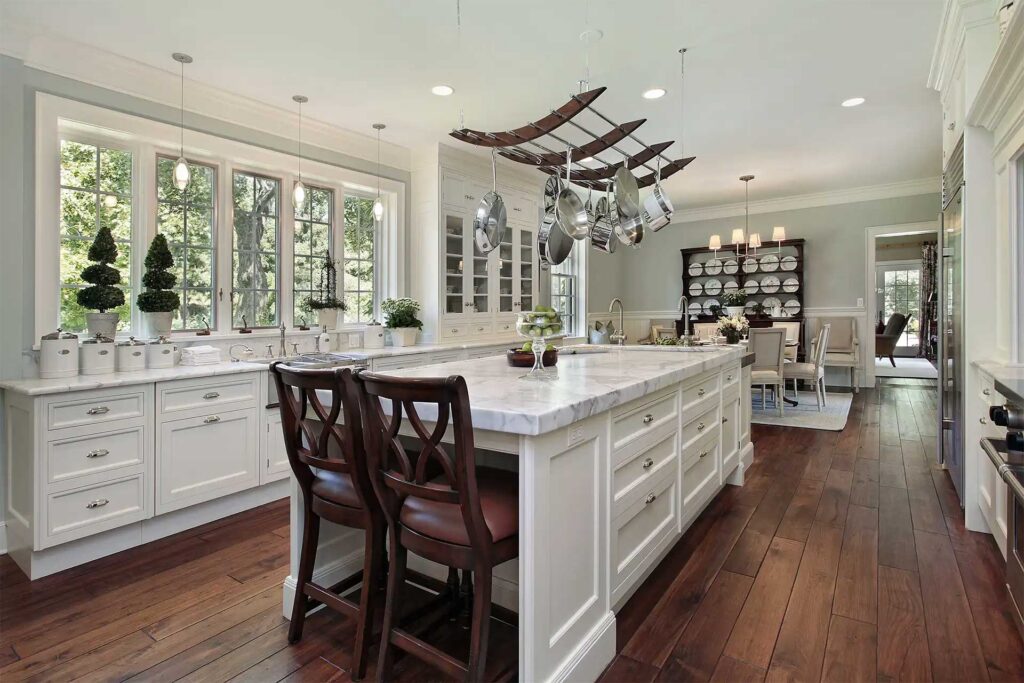
The result of that process — cabinets that are level, plumb, tightly joined, and precisely coordinated with the countertops, lighting, and flooring installed alongside them — is the difference between a kitchen that looks professionally finished and one that looks like it was assembled by someone learning as they went. For Lancaster County homeowners investing in a kitchen that will serve the family well for the next decade and beyond, that difference is not a small one.
Lancaster Kitchens & Baths: Your Partner in Kitchen Cabinet Installation
Lancaster Kitchens & Baths brings NKBA-accredited design expertise and experienced professional installation to kitchen cabinet projects throughout Lancaster County and surrounding communities.
Our Services Include:
- Kitchen Cabinet Installation — Cabinet selection guidance, detailed design with 3D renderings, professional installation, and full coordination with countertops, lighting, and flooring
- Full Kitchen Design & Remodeling — Complete kitchen transformations managed from initial consultation through final installation
Ready to Start Your Kitchen Cabinet Project? Contact Lancaster Kitchens & Baths to schedule your free consultation and see our full cabinet displays at the LKB Home Center showroom.
Works Cited
“Key Demographic Factors Will Drive K&B Remodeling Growth in 2026.” National Kitchen & Bath Association, nkba.org/research/kitchen-bath-market-outlook/key-demographic-factors-will-drive-kb-remodeling-growth-in-2026/. Accessed 26 Mar. 2026.
“10 Kitchen Remodeling Trends to Know for 2026.” Houzz, 2026, www.houzz.com/magazine/10-kitchen-remodeling-trends-to-know-for-2026-stsetivw-vs~184007085. Accessed 26 Mar. 2026.
Related Articles
- Kitchen Cabinet Installation in Lancaster County, PA: What Homeowners Need to Know in 2026
- Stock, Semi-Custom, or Custom: Which Kitchen Cabinet Grade Is Right for Your Lancaster County Home?