
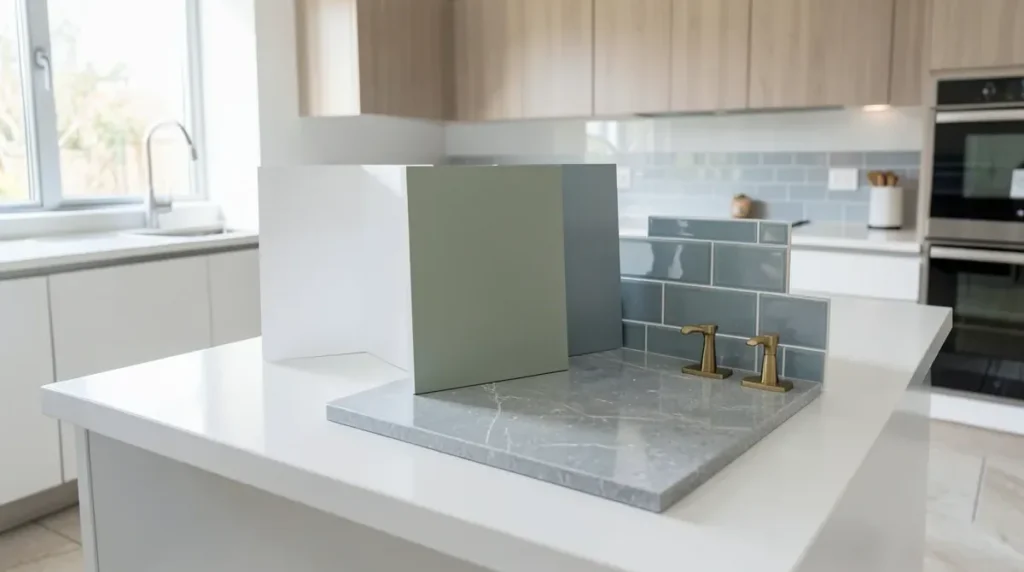
Two quotes for the same kitchen can differ by a wide margin, and the reason usually has nothing to do with cabinets. Lancaster Kitchens and Baths is a design-build kitchen and bathroom remodeling contractor serving Lancaster County, Pennsylvania, with a showroom in Landisville where clients select materials. This guide breaks a remodel price into its actual parts, shows which of those parts moved in 2026, and explains why the piece homeowners never think about is the one under the most pressure.
A Remodel Price Has Three Layers
Most people picture a remodel budget as a list of things. Cabinets, countertop, tile, fixtures.
That is one layer of three.
Goods. The physical material that arrives on a truck.
Labor. The hours of carpenters, electricians, plumbers, tile setters, and painters.
Services. Everything that moves goods and coordinates work. Freight, warehousing, trade services, and project management.
A quote is the sum of all three. When homeowners compare bids and find a gap they cannot explain, the gap is usually sitting in the second and third layers, where nothing is visible.
The Layer Everyone Watches
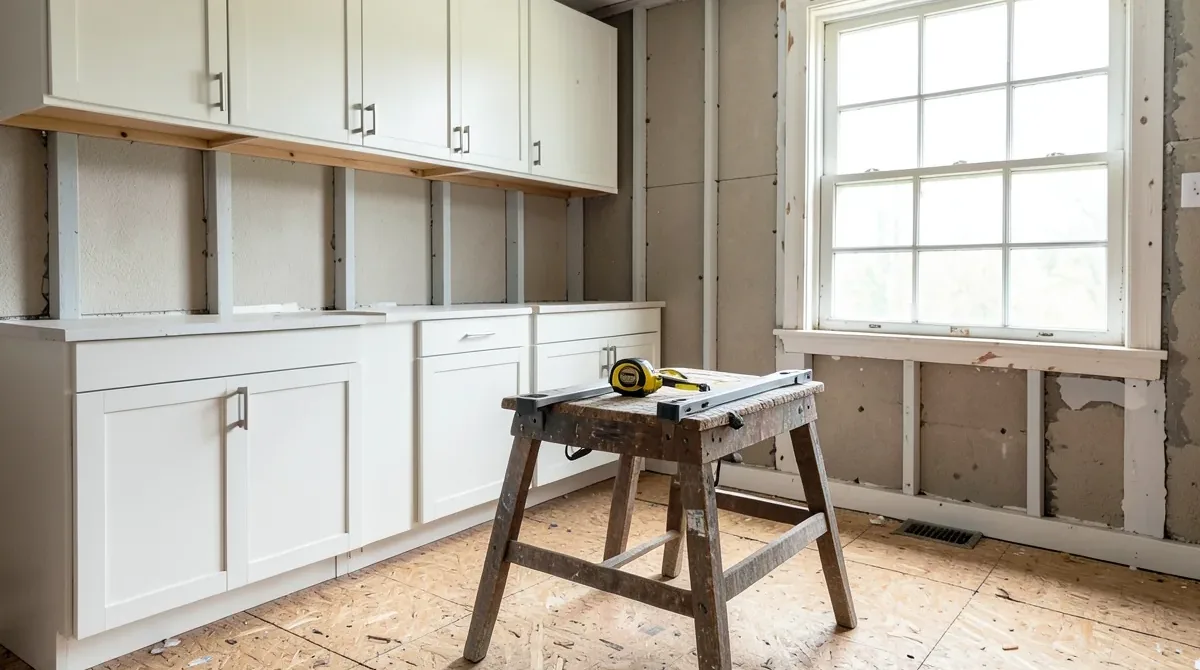
Material pricing is the part that makes the news, and it has been climbing.
According to NAHB’s analysis of the September 2026 Producer Price Index from the Bureau of Labor Statistics, building material prices used in residential construction rose 0.4 percent in September and were up 5.5 percent compared with a year earlier. That is the highest annual rate since December 2022.
The same release shows something most coverage skipped. Prices for service inputs to residential construction were up 11.3 percent from a year earlier, roughly double the pace of materials.
Freight, warehousing, and trade services are not line items a homeowner reads on a quote. They are baked into every line.
The Layer Nobody Watches
Labor is where the real constraint sits, and it has been building for a decade.
The Joint Center for Housing Studies at Harvard University reports that between 2015 and 2023, a majority of remodelers reported some or serious shortages in the availability of subcontracted workers such as carpenters, masons, electricians, and plumbers. Immigrants accounted for 34 percent of the skilled trades labor force in 2023, a record share.
That matters to a homeowner in a specific way. A skilled tile setter who is booked solid does not discount. A plumber who can choose between four jobs takes the one that is ready to go.
Price and availability are the same problem wearing different clothes.
Why the Cheapest Bid Is Often the Most Expensive
A bid that comes in well under the others has usually solved the labor problem by using cheaper labor.
Sometimes that is fine. Sometimes it means a crew that is learning on your house, or one subcontractor doing work that properly needs two trades, or a schedule built on people who will leave the moment a better job appears.
The cost shows up later. Cabinet doors that were never adjusted. Tile laid on a floor that was not levelled first. An outlet that trips when the microwave and the kettle run together.
Rework is the most expensive line in remodeling, and it never appears on any quote.
Why Local Numbers Beat National Ones
National indexes describe inputs. They do not describe your house.
Four things decide where a Lancaster County project lands inside the national range.
The age of the structure. Older framing, wiring, and plumbing add work before any finish goes in.
How much is moving. Keeping plumbing and walls where they are produces a different number from relocating either.
Which trades are involved. A project needing a licensed electrician and a licensed plumber draws on two of the tightest labor pools.
What is behind the walls. Unknown until demolition, and unpriceable before it.
How to Compare Two Quotes Honestly
Line up scope first, not totals. A lower number almost always means a smaller scope, a thinner allowance, or an exclusion you have not spotted yet.
Ask what allowances are set at and what happens when a selection exceeds one. Ask which trades are subcontracted and which are in-house. Ask what is specifically excluded. Ask how change orders are priced.
A quote with a long exclusions list is not a worse quote. It is a more honest one.
What a Contingency Is For
A contingency is money set aside for conditions nobody could see at quoting time. It is not padding and it is not a slush fund.
Older houses are where it earns its place. Failed subfloor under a dishwasher, wiring that will not carry a modern circuit, framing that is out of plumb enough to matter, plumbing that was rerouted by a previous owner without permits. None of these are visible until a wall or a floor opens.
A project budgeted to the last dollar has no answer when one of these appears. The work stops while someone decides what to cut.
Talk about the contingency openly during design. A contractor who raises it before you do is telling you they have opened walls in houses like yours before.
If timing is the next question, see our guide on why the order date decides when your kitchen is finished. If you want to know what you are actually buying in labor, see the part of a remodel nobody photographs.
Frequently Asked Questions About Remodeling Cost Drivers
01Why is labor such a large share of a remodel cost?
Because a remodel is mostly skilled hours. Demolition, framing, electrical, plumbing, drywall, tile, cabinetry, and finish carpentry are all labor, and several require licensed trades. Harvard’s research shows most remodelers have reported subcontractor shortages for years, and scarce trades do not discount their time.
02Are building material prices still rising in 2026?
Yes. NAHB’s analysis of Bureau of Labor Statistics data shows building material prices used in residential construction up 5.5 percent year over year in September 2026, the fastest annual pace since December 2022. Service inputs such as freight and warehousing rose faster still, at 11.3 percent.
03Why do two contractors quote the same kitchen so differently?
Usually scope rather than greed. Differences in allowances, exclusions, which trades are subcontracted, and assumptions about what sits behind the walls all move a total. Two bids can describe genuinely different projects while using the same room name. Compare the scope line by line before comparing the numbers at the bottom.
04What is an allowance, and why does it matter?
An allowance is a placeholder amount set aside for a selection you have not made yet, such as tile or fixtures. If your eventual choice costs more than the allowance, the difference is added. Allowances set low make an early quote look better than the finished project will.
05Does a national cost index tell me what my project will cost?
No. Indexes track input prices across the whole country and across every type of construction. They are useful for direction and timing. The age of your house, the scope of the work, and what turns up during demolition decide your actual number.
Lancaster Kitchens and Baths: Design-Build Remodeling in Lancaster County
Lancaster Kitchens and Baths handles kitchen and bathroom remodeling from design through construction, with a showroom in Landisville where you can see and touch materials before you choose them. NKBA Certified Member and a member of the Building Industry Association of Lancaster County.
Our Services Include:
- Kitchen Design and Remodeling: Layout, cabinetry, countertops, and construction from one team
- Kitchen Cabinets: Cabinet selection and installation, stock through custom
Thinking about a remodel? Get a free quote and we will walk through what the project involves.
PA Registration #153628
Works Cited
- National Association of Home Builders. “Building Material Price Inflation Nears Four Year High.” Eye on Housing, 15 Oct. 2026, eyeonhousing.org/2026/10/building-material-price-inflation-nears-four-year-high/. Accessed 28 Oct. 2026.
- Joint Center for Housing Studies of Harvard University. Improving America’s Housing 2025. Harvard University, 2025, www.jchs.harvard.edu/sites/default/files/reports/files/Harvard_JCHS_Improving_Americas_Housing_2025.pdf. Accessed 28 Oct. 2026.
Remodeling costs vary with scope, materials, structural conditions, and the age of the home. Figures here are general context, not a quote.